
TUESDAY THEOLOGY
Community Is Medicine. And It's Not a Metaphor
June 18, 2026 · Thomas Christensen
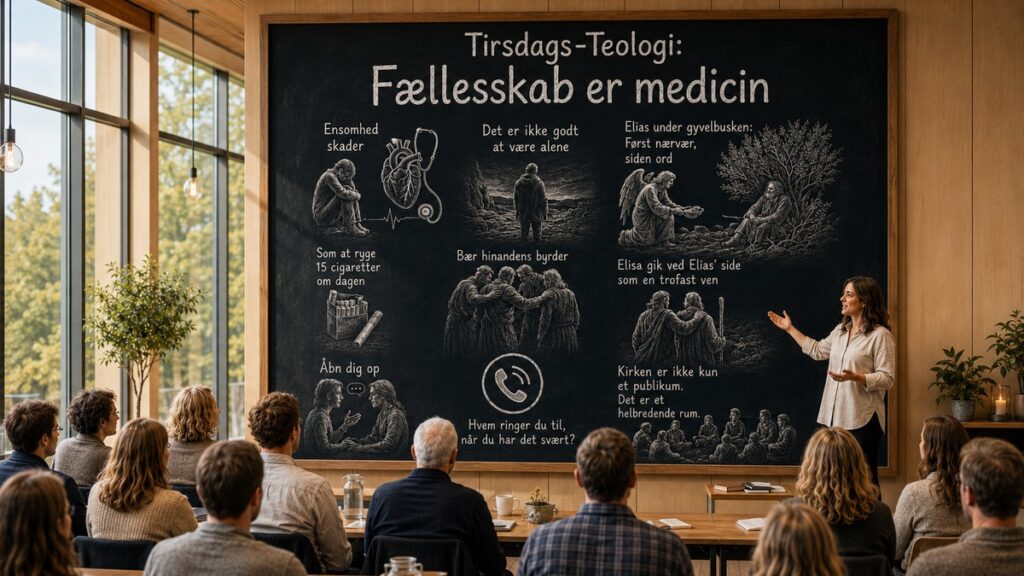
Researchers agree on something that ought to shock us more than it does.
Chronic loneliness is medically more dangerous than smoking 15 cigarettes a day.
Not a feeling. Not a question of well-being. Medically documented: isolation kills people, slowly but surely.
And the church has known it for 2,000 years.
The New Testament uses the word "one another" more than 50 times. Love one another. Carry one another's burdens. Forgive one another. Confess your sins to one another.
This isn't sentimental Christianity. It's a concrete description of a community meant to keep people alive.
Adam lived in paradise. No sin, no pain, nothing missing. And yet God said: "It is not good for the man to be alone." (Gen 2:18)
A perfect garden wasn't enough. The human being was made for community.
God hates loneliness. The Bible's first word about community.
When Elijah collapsed under the broom bush, God didn't say: "You really ought to have more faith."
He sent an angel. With food, rest and presence.
Presence first. Conversation later.
And we often skip that first step.
And when Elijah recovered, the next thing God gave him was not just a new task. It was a friend. Elisha. A man who followed him from that day and in the end refused to leave him.
God knew that Elijah didn't only need a new mission. He needed a person by his side.
I see it in the church. And I see it in myself.
We're good at coming to the service. We sing together, hear God's word, drink coffee afterward. But we're not always good at saying the hard thing.
We perform health while deep down we're struggling.
That's human. But it turns the community into an audience instead of a healing room.
The church isn't a place you visit once a week. It's the people you call when you can't sleep. The ones who pick up. The ones you don't have to explain everything to.
Professional help, a psychologist or a therapist, is also God's gift to us. It doesn't replace community, but complements it. Seeking that help isn't weakness. It's taking responsibility for your inner life.
Who do you call when you're having a hard time?
And who knows that they can call you?
We are made for one another. It's theology and medicine at the same time.
Has this stirred something in you? You are welcome to write to us — or simply come by on a Sunday. Say hello here.