
TUESDAY THEOLOGY
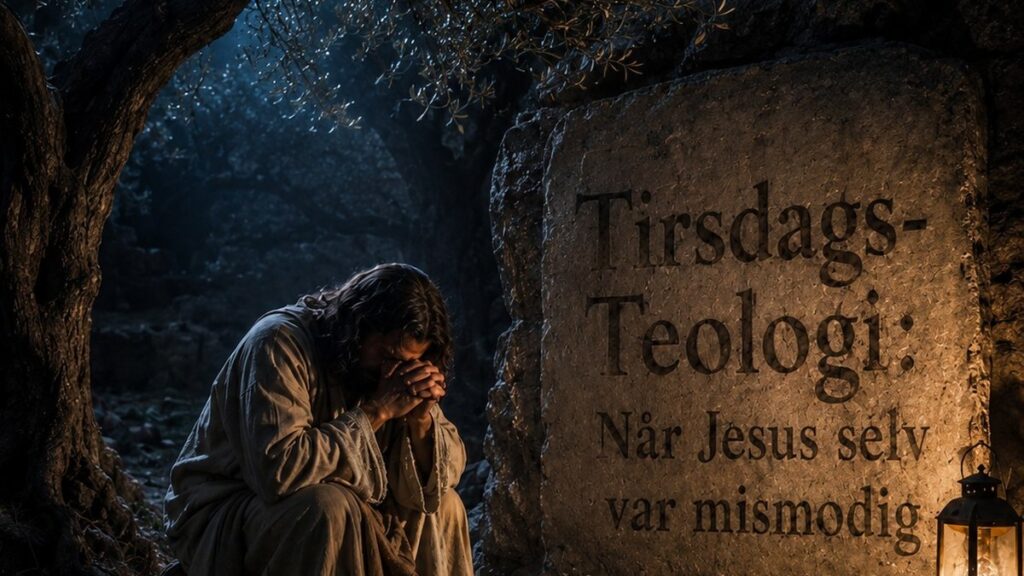
When Jesus himself was downcast
June 10, 2026 · Thomas Christensen
There's something many of us believe, but rarely say out loud:
A good Christian shouldn't be downcast.
If I believed more. If I prayed more. If I found the right sentence or the right podcast. Then the discouragement would disappear.
It's a quiet thought. But it sits in most of us. And it has a cost.
It makes us hide that we're struggling. It makes us put on a brave face while, under the surface, we carry a weight we don't know what to do with. It lays an extra burden on top of the one that's already there.
Let me say it very plainly:
Discouragement is not a sign of weak faith. It's a human experience Jesus himself took part in.
The Gospels write about it in three different places. Every time it stands out in the open. Every time it stands without explanation.
In Gethsemane
The evening before Jesus was to die, he went into an olive grove with his three closest disciples. He was going to pray.
"He was sorrowful and troubled. 'My soul is deeply grieved, to the point of death,' he said. 'Stay here and keep watch with me while I pray!'" (Matthew 26:37-38)
Notice the words. Sorrowful. Troubled. Deeply grieved.
That's not a high-functioning Son of God in full control of his emotions. It's a man on his knees in the dark, who can't bear what awaits him.
And he prays:
"Father, if it is possible, take this cup of suffering from me. Yet not as I will, but as you will." (Matthew 26:39)
He asked to be spared. The cup was not taken from him.
He prayed three times. Three times.
At Lazarus' grave
Earlier he had lost a friend. Lazarus had died. Jesus came too late — deliberately. He knew what he was going to do.
But that's not what we read about first.
"When Jesus saw her [Mary] weeping and heard the others weeping too, he was deeply moved in his spirit." (John 11:33)
And then the shortest verse in the Bible:
"Jesus wept." (John 11:35)
He wept. Even though he knew that a few minutes later Lazarus would come out of the grave, he wept.
He didn't weep over what he didn't know. He wept over what he felt.
The pain didn't remove what he had to do. But it was there. And he didn't hide it.
On the cross
Three o'clock in the afternoon. Darkness had lain over the earth for three hours.
"At three o'clock Jesus cried out loudly: 'Eli, Eli! Lema sabachthani?' That means: 'My God! My God! Why have you forsaken me?'" (Matthew 27:46)
That's perhaps the most terrible sentence in the whole Bible.
The Son — who had lived in the unbroken fellowship of the Trinity from all eternity — cried out in a moment when he had become infinitely alone.
In that second the sin of the world was laid on him. Everything we've done. Everything we've hidden. Everything we should never have done. It was laid on him — and the Father, who is holy, had to turn his face away.
That's the deepest loneliness that has ever existed. To be the Son and at the same time be cut off from the Father. To carry everything that stands between God and man — alone. Forsaken by family. Forsaken by friends. And in that one moment also by the Father himself.
So that you and I would never have to stand there.
What it means for you and me
Jesus was sorrowful. He was troubled. He was deeply grieved. He wept. He cried out.
Every time it was legitimate. Every time it was human. Every time it was faith.
What we've forgotten — or maybe were never allowed to hear — is that discouragement is not the opposite of faith.
Discouragement is something a believing body and a believing soul do when they meet something too big.
It does it together with Jesus. Never outside of him.
When you're downcast today, you're in the company of the One who carried it all the way to the cross.
He knows it from the inside. He didn't hide it. He didn't put on a brave face.
He asked to be spared, knew that he wouldn't be, and walked the way obediently anyway.
The letter to the Hebrews puts it like this:
"Let us fix our eyes forward on Jesus, who started us on the journey of faith and will also lead us to the goal. By looking ahead to the joy that awaited him, he could endure the shame and death of the cross, and now he sits on the throne at God's right hand." (Hebrews 12:2)
You were the joy he looked forward to.
The fellowship with you. That you would be able to stand freely before the Father — without distance, without shame, without forsakenness. That you would be able to come home.
He was rejected so that you could be accepted.
He was made alone so that you would never have to be.
He carried the whole distance between heaven and earth, so that there's no longer any distance between you and your heavenly Father.
And that's why his last words to the disciples, before he ascended to heaven, are these:
"And remember: I am always with you, to the very end of the age." (Matthew 28:20)
You are not alone in your darkness.
Also when you can't see him. Also when you can't feel him. He is there — close by.
He has promised it. And he has paid the price to be able to keep that promise.
What would you answer if Jesus asked you the question today:
Where are you carrying some discouragement you haven't dared to say to me?
Feel free to write it — or just answer him quietly. That's where the important thing happens.
That's my take on Tuesday Theology — have a blessed day and add your input to the conversation 🙏
Has this stirred something in you? You are welcome to write to us — or simply come by on a Sunday. Say hello here.